Olympia v the Roxy Girls
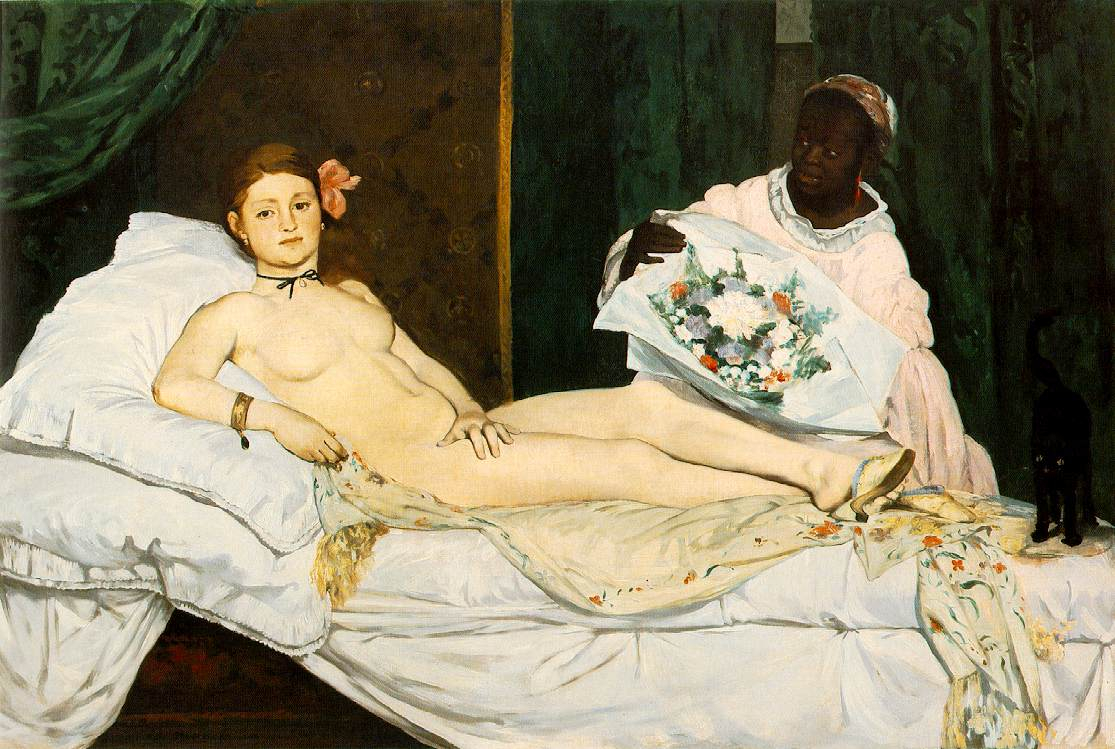
Édouard Manet, "Olympia" (oil on canvas, 1863), Musée d'Orsay, Paris
Much of Olympia (2011) came from the sessions of what would have been Roxy Music’s reunion album – a full reunion, including Brian Eno – announced as such some five years earlier, and as such, generating a fair amount of trepidation. Eventually, Bryan Ferry decided the reunion wasn’t such a good idea after all, and the material was remodelled.
It was the right decision. Echoes of Roxy notwithstanding, Olympia was very much his album, and none the worse for that. Getting Ferry, Eno, Manzanera and McKay back together in the lab still produces something pretty special, but the reaction that gave us Virginia Plain (1972) would have been impossible to recreate: after 40 years of changes to its elements, it would be insane to expect the formula to yield the same results. That is fine: Virginia Plain is still here, as are Roxy Music (also 1972), Pyjamarama and For Your Pleasure (both 1973), regularly remastered and reissued, readily available. They need no re-making or re-modelling; in fact, it would have been offensive for Roxy to get back together and rehash their early work. Reviving Roxy Music would only have made sense were they to have returned with something as revolutionary as the first time around.
Olympia’s cover girl is Kate Moss, photographed by Adam Whitehead. As usual, Ferry was art director. This is the first of his solo albums to feature a model at the front (the prostrate Cleopatra with asp from The Bride Stripped Bare (1978) appear on the back cover): a direct link to the Roxy albums, which, apart from Manifesto (1979) and Avalon (1982), all feature “cover stars” in pin-up poses. But is Olympia, in fact, truly a Roxy Girl?
Let pictures speak. First, Kate Moss as Olympia.

Kate Moss in "Olympia" (Virgin, 2010); ph. Adam Whitehead, art direction Bryan Ferry
Then, Kari-Ann Muller for Roxy Music.

Kari-Ann in "Roxy Music" (Island, 1972); ph. Karl Stoecker, concept Bryan Ferry, art Nicholas de Ville / CCS
Kate looks distinguished. She harks back to classic fashion and Hollywood and, unlike Kari-Ann, owes nothing to pin-ups. Roxy Music’s cover is Pop art; all Roxy Music covers are, in fact, except perhaps that of Avalon, which is arguably really a Bryan Ferry solo album. [1] Ferry and his lifelong visual collaborator Nicholas de Ville did not study under Richard Hamilton in vain.
(Hamilton influenced them well beyond Pop. He worked with Marcel Duchamp, and it’s not a huge leap to assume this had something to do with Ferry’s occasional referencing of Duchamp in his own work. For instance, The Bride Stripped Bare doesn’t limit itself to name-checking La mariée mise à nu par ses célibataires, même twice, on its title and in a lyric: its cover features a direct visual reference to La mariée’s cloud for good measure.

Barbara Allen in "The Bride Stripped Bare" (E'G Records, 1978): ph. John Swannell, design Antony Price, artwork Cream, typography Brian Harris

Marcel Duchamp, "La mariée mise à nu par ses célibataires même" (oil, varnish, lead foil, lead wire, and dust on two glass panels, 1915-23), Philadelphia Museum of Art
In the same way, it’s not hard to see a parallel between the cover of Stranded (1973)

Marilyn Cole in "Stranded" (Island, 1973); ph. Karl Stoecker, design Nicholas de Ville, concept Bryan Ferry, artwork Bob Bowkett / CCS
and Étant Donnés.)

Marcel Duchamp, "Étant donnés: 1° la chute d'eau / 2° le gaz d'éclairage" (wooden door, bricks, velvet, twigs, pig skin, glass, linoleum, electric lights, photography, electric motor, tin, perforated disc, 1946-66), Philadelphia Museum of Art (detail)
But no Pop sensibility is apparent from Olympia’s cover (let alone any Duchamp). Its glamour seems straightforward, free of irony or provocative edges. There seems no sense of intentional misplacement, of an image that “doesn’t belong” being recuperated or recontextualised: Kate’s luxurious photo is perfect where it is, as it is and for what it is. It bears no signs of exaggeration or caricature; it is harmonious, classical (within its context), serene in its preordained position. If there is any camp to it at all, it’ll be at best of the most rarified variety that can still conceivably be identified as such.
This could be a sign of the times, of the passing of time, of history: is it still possible to make Pop art? Please don’t think I’m speaking of images that look like Pop; these are easy to make, and fairly common. I wonder, however, if any such images really count as Pop, or will be at their closest meta-Pop, commentaries on commentaries. For what could be more essential to Pop than the appropriation of the supposedly trite, banal or commercial and its re-proposition as something worthy of artistic appraisal? In other words, the revealing of the taken for granted as something else (even if it doesn’t cease to be what it already was)? How can such a thing be repeated, once it has been done? Going back to Duchamp for a moment (and to something I harp on quite often), to sign an upturned pissoir is not something that can be done twice. As Sondheim has explained, twice loses the spark. Thinking about it further, this might be true of Impressionism, Fauvism, Cubism, Surrealism, Dada, Futurism, Vorticism and any other movement, each to the exact proportion it should rely on the sense of novelty for its impact.
Of course, any work that aspires to longevity will need more to draw from than the shock of the new, and apart perhaps from one or two hybrids of landmark and hand grenade (extremely few and usually far between), any work that has made it into museums and art history books is sure to have more than its immediate wow factor to offer. Which is why it is perfectly possible, still, to produce work in the manner of the Cubists, Surrealists and so on, even if it’s probably going to look a little recherché, and one would better have a compelling justification at hand for the style adopted. Pop revival attempts, however, seem particularly vulnerable in this respect; not because Pop necessarily had less substance than any other movement (though some of its greatest artists might have told you just that), but because so much of its substance, and of its lasting importance, had to do with hand grenades.
If Kate’s and Whitehead’s Olympia isn’t Pop, she doesn’t seem easy to compare to Manet’s either. She was the scandal of the 1865 Salon; the second time a Manet painting would cause apoplexy. (The rejection of Le déjeuner sur l’herbe in 1863 did not keep it from causing a stir: it was exhibited in the Salon des Réfusés, where it garnered reactions that varied from the indignant to the borderline violent.) The woman in both paintings was his favourite model Victorine Meurent, who posed for seven more of his paintings. Herself a painter of a much more academic bent (though nearly all of her works are now lost), she would exhibit at the Salon six times (starting from 1876, when Manet’s own submissions were rejected). Olympia is however not a portrait at all: it represents a prostitute, probably of high rank, but without any of the traditional attempts to make the theme more palatable through allegories or historical settings. Instead, Manet chose a cold, confrontational (and because of that shocking) realism. There is no sign of lust or perturbation of any kind about her; no, she is serene, perfectly composed – one could almost say demure. She is confident and proud; as such, truly threatening to contemporary mores. And she may have been satirical: Olympia was perceived as a mockery of classical female nudes, the goddess made whore (and perhaps not only the goddess: it has been speculated that Manet may have been referring to Napoleon III’s mistress).
One might argue that Manet’s direct inspiration, Titian’s Venere d’Urbino, had already gone quite some way towards making the goddess human, and it has been claimed that she too was a courtesan.

Titian, "Venere d'Urbino" (oil on canvas, 1538), Galleria degli Uffizi, Firenze
There is however no direct evidence of this in the Titian: she could perfectly be – in fact, probably was – simply a wife [2]; and if his Venus, like Olympia, gazes directly at us, it is much more warmly, and she certainly shares neither the former’s ennui nor her hardness: compare Titian’s delicate colours and soft lights to Manet’s near brutality of treatment. (Whitehead’s and Kate’s Olympia is certainly much closer to Titian in this aspect.)
Titian’s Venus is herself a descendant of Giorgione’s Sleeping Venus (which Titian completed), every bit as carnal as her successors.

Giorgione, Venere Addormentata (oil on canvas, c. 1510), Gemäldegalerie Alte Meister, Dresden
Yet she sleeps: decorously, passively submitting to our stare and arguably unaware of her own sensuality. Titian’s Venus (which apparently was intended as an inspiration to the Duke of Urbino’s young bride) and Kate’s and Whitehead’s Olympia, on the other hand, look back without shame, invitingly, playfully even, fully aware of their state and their effect on us (Kate looks perhaps ever so slightly coy). Manet’s Olympia’s look, in contrast, is cold and defiant. As are Roxy’s cover stars in their affected attitudes, Pop contrivance cranked all the way up into comedy. And unavoidably, unfailingly distant.
Ferry explained the choice of Kate Moss, “the femme fatale of our age, as controversial as she is beautiful”, for Olympia’s cover girl since “she could convey the glamorous notoriety of the original ‘Olympia’ painting”, which he described as “a kind of early pin-up picture”. With all due respect, this is not entirely convincing, at least not the parts that attempt to stick to the present tense. Certainly, any controversy he may be referring to must be strictly a memory.
Unlike her namesake, Ferry’s Olympia has no aggression, mockery or defiance about her, no suggestion of the illicit other than perhaps a vague historical footnote, a memory that this used to be a nom de guerre favoured by higher-end courtesans. And if Kate is indeed representing a courtesan, there is no doubt it will be of the very best quality, who might be brought to the Embassy ball without fear of embarrassment or awkwardness. And she would be merry, kittenish and pliant.
Manet’s Olympia, on the other hand, looks indifferent; almost bored. It might be in self-defence, it might be pre-emptive aggression: it might be that she genuinely doesn’t care. Whatever it is, she is daring us to look down on her. Not merely look at, but down on; to disdain and call her cheap and tacky – and in doing so, to helplessly show ourselves hypocrites and philistines. In their own infinitely less circumspect way, for their own far more colourful purposes, the preening, sneering Roxy Girls have the same answer ready should we commit the same mistake: you really don’t get it, do you?
While Kate, Kate looks almost eager to please; but then, why shouldn’t her? Times have changed, it looks as if the shoot was great fun, and her business now is entirely other. She has no need to defend a position long since set in stone, she can afford to pay it a romantic, playful tribute. Moss may have raised more than her share of ruckus when she was an enfant terrible supermodel, and indeed as controversial as Ferry defines her. (The “femme fatale of our age” accolade might need to be jostled for with quite a few other likely candidates.) In this, Ferry is right, she is indeed somewhat like Manet’s Olympia, or perhaps even like Victorine Meurent: she was once a scandal. Now, like Ferry, like Pop, more than having become established, she is establishment. This sets her even further apart from the other Roxy Girls, none of which was already a household name, let alone as big as Kate, when their respective album covers came out. (Amanda Lear and Jerry Hall were still making their way back then.)
There can be no doubt that nostalgia does make Bryan Ferry tick. Roxy Music’s and his solo albums are drenched in it. (Ferry’s solo career is approximately 60% cover versions, including of Roxy tracks.) It’s one of the elements that made early Roxy Music so startling: they seemed to have come from the future full of dewy-eyed memories of a present half-fused with the past (e.g. “2HB” from the first album, or “If there is something” with its climax of a bunch of kids barely in their twenties sighing about “when we were young”), so that the sounds of yesterday repeatedly jarred against tomorrow – or maybe it was the other way around – and the collisions produced almost unbearable excitement. I always thought Eno wouldn’t have lasted long in Roxy Music even if there had been no grand ego clash; he was far more interested in the future, and not pliant enough not to feel constrained by Ferry’s longing for the past. Once Eno had left, Ferry, and time, and consolidation would progressively steer Roxy ever further towards the nostalgic end of the spectrum. (Ferry’s solo career was already geared towards that from the start.) This is not to call Roxy or Ferry conservative or backward looking; rather, nostalgia was the material they were refashioning into new, original shapes. But at some point, the refashioning became more like refining, and while the process still regularly yielded precious results, they could no longer be called “new”; not in the sense Virginia Plain had been. This is natural, and may well be inevitable.
Olympia features wistful couplets about “rock n’ roll desire” and an ambivalent attitude to the latest media (e.g. his references to Facebook and YouTube); and sounds and concerns squarely in the Ferry tradition. I wonder whether, in choosing Kate as Olympia’s cover girl, Ferry wasn’t – even if maybe unconsciously – highlighting the differences between rebellious then and regal now (just compare the simple string around the neck of the former, surely not a question of means as her surroundings are visibly not modest, to the dazzling choker Kate displays), demonstrating visually why Olympia could never have been that Roxy album; admitting that that reunion will never be, that you can never go back, and even less because you made it in the end. After all, Moss herself, gamine though she may still look, became through longevity as much of a grande dame as any other famous model from the era, and nothing she can do or say will ever reboot that outsider frisson.
True public acceptance does not sit easily with surprise. In fact, not even a steadfast rejection of acceptance is guaranteed to do the trick: constant breaks with convention tend to become a convention in themselves, never doing the same thing twice can quickly become one’s defining trait – and where to go, after that? It’s not that established artists must be incapable of surprising us again, [3] but it becomes much harder to do because their very prior career will likely stand in the way. Think, for example, of those actors and actresses who first became famous for being protean, and who, down the line, though their skills be much better honed than in the beginning, become so well known that all the technique in the world will never allow the public to forget who is it that is performing.
But – and this is why Olympia, if it is a throwing in of the towel in this respect, is the most exquisite such gesture imaginable, worthy of the gentleman Ferry is – if one can’t be that revelation again, one can dream of it, and the fact that it is just a dream can make the description of it even more poignant, and the tribute more moving. In every dream home a heartache, but that doesn’t really matter when it makes such beautiful sounds.
Notes
[1] You could make the case that the last “true” Roxy album was their 1979 reunion Manifesto, the last work to feature (relatively) looser, noisier songs or display any trace of the old stomping arriviste chutzpah (some would describe it as “rock n’ roll”). Also, the scene was undergoing a transformation at the time, there was novelty (or at least renewal) in the air. Not that anybody was making any claims to be as fresh as when they had started; once again, the cover (complete with Blast typeface) speaks volumes.

Cover of Roxy Music's Manifesto (E'G Records, 1979); ph. Neil Kirk, design Antony Price, Bryan Ferry, artwork Sally Feldman / Cream
Manifesto’s follow-up Flesh + Blood (1980), nominally the seventh Roxy Music album, actually drew the definitive template for the rest of Ferry’s solo career – dreamy, sleek, luxurious, tightly arranged and controlled, utterly devoid of any rough or jagged edges. Avalon then proceeded to set it in stone.
[2] The dog at her feet has been read as a symbol of infidelity because it is asleep; but it could just as well symbolise tranquil domesticity, as do the matching linen chests in the background, implying a marriage. Olympia’s cowering black cat, on the other hand, will fit no such interpretation.
[3] It does happen: more often than not when the artist engages in a slash-and-burn exercise. For instance, Lou Reed’s Metal Machine Music (1976), which he would later unwaveringly defend as a perfectly serious experimental piece. (Many prefer to still regard it as he first proposed it: his fuck-you to RCA.) Another case in point is Sparks’s Lil’ Beethoven (2002), the fruit of their sudden revulsion at the pop they were hearing around them, which led them to scrap an entire near-finished album rather than risk contributing to the status quo. Lil’ Beethoven turned out to be Sparks’s critical renaissance, so well received that it became the template for, so far, three further albums.
(As usual, here are the links to people / institutions on the photo captions (where I was able to find them – links to CCS, Cream, Brian Harris, Barbara Allen, Bob Bowkett and Sally Feldman would be welcome): Musée d’Orsay, Karl Stoecker, Antony Price, John Swannell, Philadelphia Museum of Art, Marilyn Cole, Galleria degli Uffizi, Gemäldergalerie Alte Meister Dresden, Neil Kirk.)

Tags: art, Bryan Ferry, Duchamp, fashion, Giorgione, Lil' Beethoven, Lou Reed, Manet, Metal Machine Music, nostalgia, Olympia (album), Olympia (painting), Roxy Music, Sleeping Venus, Sparks, the "Fountain" principle, Titian, Venus of Urbino